


Under Eye Filler Denver: Clinical Precision for Tear Trough Restoration
Updated: Sep 29
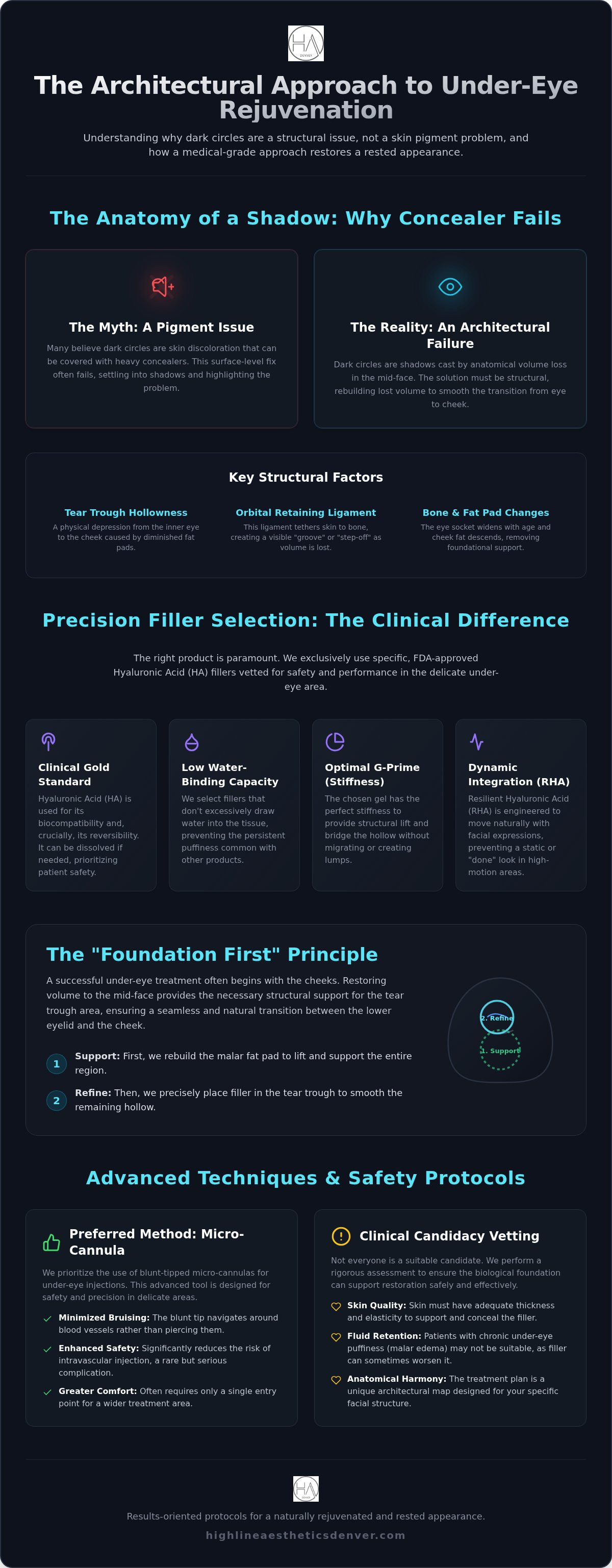
Dark circles are rarely a skin pigment issue. They're an architectural failure of the mid-face. If you've spent years layering heavy concealers only to have them settle into deep shadows, you've realized that surface-level fixes can't address a loss of structural volume. This persistent hollow look often makes you appear exhausted even when you're fully rested. At Highline Aesthetics Denver, we approach under eye filler Denver as a precise anatomical reconstruction rather than a simple cosmetic mask.
You deserve a solution that prioritizes safety and scientific validation over fleeting beauty trends. We understand that the idea of needles near the ocular area creates hesitation. That's why our disciplined, medical-grade approach focuses on clinical rigor and deliberate placement. In this guide, you'll discover how medical-grade tear trough fillers restore the transition between the eye and cheek to eliminate dark hollows. We'll detail our selection process for FDA-approved fillers and explain how our results-oriented protocols ensure you look naturally rejuvenated, rested, and never overfilled.
Key Takeaways
Learn why under-eye shadows are often caused by anatomical volume loss rather than skin pigment. Addressing the structural hollow is the only way to eliminate the tired look.
Discover why we utilize specific hyaluronic acid fillers with low water-binding properties. This deliberate selection prevents the post-treatment puffiness common with inferior products.
Understand the Foundation First principle. Restoring cheek volume is often required to provide the necessary support for a smooth tear trough transition.
See how advanced techniques like blunt-tipped micro-cannulas and vascular mapping prioritize your safety. These methods minimize bruising and protect delicate ocular structures.
Explore the structured process for receiving under eye filler denver at our boutique Golden Triangle clinic. Every treatment plan is a unique architectural map designed for your specific facial anatomy.
Table of Contents
The Anatomy of Fatigue: Understanding Tear Trough Hollowness
The tear trough is the anatomical depression extending from the inner corner of the eye down toward the upper cheek. When this area loses volume, light reflects poorly, creating the dark shadows often mistaken for simple skin discoloration. These shadows are physical manifestations of structural deficits. The orbital retaining ligament plays a critical role here; it's a fibrous band that tethers the skin to the underlying bone. As fat pads diminish or shift, this ligament remains fixed, creating a visible "step-off" or groove that defines the hollow. This tethering is why the area looks sunken rather than just tired.
Patients often attempt to resolve this with topical creams. While high-quality skincare improves texture, it cannot replace lost subcutaneous fat or bone. Injectable fillers provide the necessary mass to bridge this gap, offering a solution that topical treatments simply can't replicate. If the problem is structural, the solution must be structural. Our approach to under eye filler Denver focuses on this clinical reality, treating the root cause of the shadow rather than just the surface.
The Impact of Age on Periorbital Structure
Aging involves more than skin laxity. Over time, the orbital rim actually widens through bone resorption, providing less surface area for soft tissue to rest upon. Simultaneously, the malar fat pad, which is the primary support for the mid-face, begins its descent. This downward shift leaves the lower eyelid without a foundation, causing the tear trough to appear deeper and more elongated. A tear trough is a structural volume deficit occurring at the junction of the eyelid and cheek.
Genetics vs. Aging: Who is a Candidate?
Not all hollows are created by time. Some patients possess a genetic predisposition for deep-set eyes, where the tear trough is prominent even in youth. Others experience age-related volume loss that manifests in their 30s or 40s. Identifying the root cause is essential for a successful outcome with under eye filler denver. We look for specific anatomical markers during our deliberation:
Skin Thickness: Thicker skin hides filler better, while very thin skin requires extreme precision and specific product selection.
Elasticity: The skin must have enough snap to support the product without creating a heavy or unnatural appearance.
Fluid Retention: Patients with chronic malar edema or severe lower lid laxity may not be suitable candidates, as filler can sometimes exacerbate fluid pooling if the lymphatic system is compromised.
Our clinical vetting process ensures that we only proceed when the biological foundation can support the restoration. We don't believe in "good enough" results; we prioritize long-term safety and anatomical harmony.
Precision Selection: The Clinical Vetting of Under-Eye Fillers
Selecting the right product for the infraorbital region requires more than brand recognition. It demands a deep understanding of rheology. Hyaluronic Acid (HA) remains the clinical gold standard because of its biocompatibility and reversibility. Safety is paramount. If a complication occurs, HA can be dissolved. This aligns with foundational dermal filler safety protocols that every patient should prioritize. We act as selective curators, vetting every product for its performance in the delicate periorbital space.
In the tear trough, we exclusively use fillers with low water-binding capacity. Many standard fillers are highly hydrophilic; they pull water into the tissue. In the thin skin under the eyes, this leads to persistent puffiness or a blueish tint known as the Tyndall effect. By selecting products with specific G-prime ratings-the measurement of a gel's stiffness-we ensure the filler provides enough structural lift to bridge the hollow without migrating. This is the difference between a result that looks "done" and one that looks anatomically correct. Our expertise in under eye filler denver ensures that the product choice matches your specific skin thickness and bone structure.
The RHA Collection: Dynamic Integration for Natural Movement
Traditional fillers can sometimes look static in high-motion areas. The mid-face is constantly active. When you smile or squint, the muscles around your eyes contract significantly. Resilient Hyaluronic Acid (RHA) is engineered to move with these expressions. RHA 2, specifically, uses a unique manufacturing process that preserves the natural length of the HA chains. This results in less chemical cross-linking, allowing the gel to integrate into the tissue seamlessly. It avoids the stiff, unnatural appearance often seen with older technologies. It provides a smooth transition that remains invisible even during peak facial movement.
Restylane-L and the Art of Precision
Restylane-L has a long history of efficacy for structural tear trough restoration. It offers a firm, defined lift that is ideal for patients with deeper grooves or more significant volume loss. The integration of lidocaine ensures the injection process is comfortable for the patient. Most find the sensation quite manageable. When considering under eye filler denver, the choice of technology is the most critical variable in your outcome. In terms of longevity, these treatments typically last between 9 and 15 months. Your individual metabolism and the specific product used will dictate the exact timeline. If you're ready to see which structural plan fits your anatomy, we invite you to explore our dermal filler services at our Denver clinic.
Structural Synergy: The Cheek-Eye Connection
The tear trough is not an anatomical island. It represents the delicate transition between the lower eyelid and the cheek. If the mid-face loses its structural integrity, the under-eye area inevitably collapses. We operate under the Foundation First principle. Without a stable cheek platform to rest upon, any attempt at under eye filler denver will likely result in an unnatural or shelf-like appearance. The mid-face serves as the literal foundation for the periorbital region.
When mid-face fat pads descend due to aging, they create a downward gravitational pull. This displacement drags the tear trough downward, which elongates the shadow and makes the hollow appear more severe than it actually is. By treating the lateral cheek first, we create a lifting vector that provides indirect support to the lower lid. This tension eases the depth of the groove before we even touch the infraorbital area. This comprehensive strategy allows us to achieve anatomical symmetry by addressing the face as a cohesive, biomechanical unit.
The Mid-Face Restoration Protocol
A youthful, vibrant profile is defined by the Ogee Curve. This is the subtle, S-shaped curve visible from a three-quarter view, where the cheek transitions smoothly into the mid-face. As volume diminishes, this curve flattens and light no longer reflects off the high points of the face. We use deep-plane cheek filler to restore this light-reflective surface. If we rebuild the foundation, we often find that the patient requires significantly less superficial filler in the tear trough itself. This efficiency is a core component of our approach to facial balancing cost and outcomes. We prioritize structural logic over simply filling a hole.
Avoiding the "Overfilled" Look
Injecting the tear trough in isolation is a frequent clinical mistake that leads to the dreaded "sausage" look. If the surrounding tissue lacks the density to support the product, the filler sits prominently on top of the bone and creates persistent puffiness. At Highline, we practice Selective Refinement. We don't believe in volume for the sake of volume. We look for specific clinical markers, such as malar flattening or nasolabial deepening, to determine the correct sequence of treatment. If these signs are present, it's a clear indicator that the patient needs cheek support rather than more under-eye filler. This disciplined methodology ensures that your results look rested and authentic, never "done" or over-processed.
The Safety Protocol: Advanced Injection Techniques in Denver
Safety in the periorbital region isn't a suggestion; it's a mandate. The area is dense with delicate vasculature, including the infraorbital artery and various branching veins. Mistakes in this zone can have significant consequences, which is why we treat every injection as a high-stakes medical procedure. We utilize vascular mapping to visualize the arterial architecture before any product is placed. This deliberation ensures that under eye filler denver is administered with medical-grade precision. Our boutique clinic operates under strict sterile techniques and rigorous medical-director oversight to maintain the highest standards of safety and efficacy.
Vascular knowledge is non-negotiable for any practitioner. We don't just "fill" shadows; we navigate a complex three-dimensional landscape of nerves and vessels. By identifying the exact location of the infraorbital foramen, we can safely avoid critical structures. This disciplined approach minimizes trauma and ensures the filler is placed in the intended anatomical plane. Our commitment to clinical rigor means we never rush the mapping process. Every face is different, and every injection plan is customized to that specific patient's vascular reality.
Micro-Cannula vs. Traditional Needle
We've transitioned away from traditional sharp needles for tear trough restoration in favor of blunt-tipped micro-cannulas. Sharp needles increase the risk of piercing blood vessels, which causes extensive bruising or vascular occlusion. Micro-cannulas are the superior choice for this high-risk area. Because the tip is rounded, it slides past vessels and nerves rather than cutting through them. This technique requires only a single entry point to treat the entire under-eye area through multi-vector placement. Micro-cannulas allow for precise placement in the deep sub-orbicularis oculi fat (SOOF) layer. This depth is critical for hiding the product under the muscle and achieving a smooth, light-reflective surface.
Managing Complications: The Role of Hyaluronidase
Confidence in a medical procedure comes from knowing a safety switch exists. Hyaluronidase is a specialized enzyme that instantly dissolves hyaluronic acid fillers. While we aim for perfection in every treatment, having this reversal agent on-site is a non-negotiable safety standard. It's used to correct the Tyndall effect, which occurs when filler is placed too superficially and creates a blueish tint. If you've had a poor experience elsewhere, we can use hyaluronidase to reset the anatomy before starting a new, structured plan. Highline maintains full emergency protocols to ensure every patient is protected.
Post-treatment management is just as vital as the injection itself. Patients should expect minor swelling as the HA integrates with the tissue. We recommend avoiding strenuous exercise and high-heat environments for 24 to 48 hours to prevent unnecessary inflammation. If you're ready to experience a disciplined approach to under eye filler Denver, book your clinical consultation at Highline Aesthetics today.
The Highline Experience: Under Eye Rejuvenation in the Golden Triangle
Highline Aesthetics Denver operates as a boutique clinical environment in the Golden Triangle. We don't subscribe to the high-volume model of traditional med-spas. Instead, we prioritize a disciplined, expert-led approach to every under eye filler denver procedure. Every face presents a unique set of anatomical challenges. Our role is to map these variables with medical-grade precision. This deliberation ensures that your results are not only effective but also sustainable over the long term. We act as your serious partner in this aesthetic journey. We value substance over fleeting industry trends.
Comprehensive rejuvenation often requires a multi-modality approach. While fillers address volume loss, dynamic wrinkles around the eyes are best treated with neuromodulators. Integrating Botox Denver into your plan allows us to smooth crow's feet and refine the final aesthetic. This synergy between structural restoration and surface refinement creates a truly rested appearance. Maintenance is also a deliberate part of our protocol. Structural integrity isn't a one-time event. We typically schedule follow-up assessments every 9 to 12 months to monitor product integration and natural aging shifts.
Your Initial Clinical Assessment
The journey begins with a rigorous physical evaluation. We conduct a "snap-back" test to measure lower lid skin elasticity. If the skin lacks resilience, we may suggest alternative skin-tightening protocols before proceeding with filler. We also examine the degree of fat pad herniation and the level of skeletal support provided by the orbital rim. These factors dictate the volume and placement of the product. By setting realistic expectations for shadow reduction, we ensure that our patients understand the structural limitations of their anatomy. We then design a tiered treatment plan, often utilizing our aesthetic memberships to manage multi-session transformations. This structured process removes the guesswork from your care.
Recovery and Results: The First 14 Days
Patience is part of the clinical process. The first 14 days post-injection are designated as the "settling" period. During this time, the hyaluronic acid integrates with your natural tissues and any initial edema subsides. It's essential to follow our strict post-care instructions to ensure optimal outcomes. Avoid strenuous exercise and high-heat environments like saunas or hot yoga for at least 48 hours. These activities can increase blood flow to the face and exacerbate swelling. Once the two-week mark is reached, the final structural result manifests. Schedule your under-eye consultation at Highline Aesthetics Denver today.
Precision Restoration: Securing Your Structural Results
Restoring a youthful periorbital appearance requires more than a surface-level fix. It demands a deep understanding of facial biomechanics and the disciplined application of medical-grade fillers. By prioritizing the foundation-first principle and addressing the cheek-eye synergy, we ensure that your results look authentic and remain structurally sound. Every protocol we implement is designed with clinical rigor. This includes specialized micro-cannula safety protocols and direct oversight by our Medical Director.
Choosing under eye filler denver at our boutique Golden Triangle clinic means you're partnering with specialists who value evidence over trends. We don't settle for "good enough." We provide personalized care that respects your unique anatomy and delivers high-end refinement. If you're ready to eliminate persistent shadows and restore your mid-face volume, the next step is a structured assessment of your goals. Book Your Under Eye Consultation at Highline Aesthetics Denver and discover the security of scientific validation. You deserve to look as rested as you feel.
Frequently Asked Questions
Is under eye filler painful?
Most patients describe the sensation as a light pressure rather than acute pain. We use fillers integrated with lidocaine to ensure immediate comfort during the procedure. Our reliance on blunt-tipped micro-cannulas significantly reduces the needle sticks required, which minimizes tissue trauma. A topical numbing agent is also applied beforehand as a standard safety protocol. This disciplined approach ensures the experience is manageable for even the most needle-apprehensive clients.
How long does under eye filler last in 2026?
Under eye filler denver typically maintains its structural integrity for 9 to 15 months. Longevity depends on your individual metabolic rate and the specific rheology of the product used, such as RHA 2 or Restylane-L. Because the under-eye area has low mobility compared to the lips, the hyaluronic acid gel degrades more slowly. We monitor your results during scheduled maintenance visits to determine the optimal time for a structural refinement.
Will filler get rid of my dark circles completely?
Filler addresses dark circles caused by anatomical shadows and volume deficits, but it won't resolve skin hyperpigmentation. A clinical assessment helps us identify if your darkness stems from:
Structural shadowing due to deep tear troughs.
Thin skin revealing underlying vascular structures.
True dermal hyperpigmentation.
If the issue is structural, under eye filler denver is the gold standard solution. If it's pigment, we'll suggest adjunct medical-grade skincare.
Can under eye filler cause blindness?
Vascular occlusion leading to vision loss is an exceptionally rare complication, but it's a risk we take seriously through rigorous safety protocols. We mitigate this through deep anatomical knowledge and the use of blunt-tipped cannulas, which are less likely to enter an artery than sharp needles. Our practitioners utilize vascular mapping to identify critical pathways before injection. Having emergency reversal agents like hyaluronidase on-site is a non-negotiable standard for our clinical practice.
What is the Tyndall effect and how do you avoid it?
The Tyndall effect is a blueish discoloration that occurs when hyaluronic acid filler is placed too superficially, causing light to scatter. We avoid this complication by placing the product in the deep sub-orbicularis oculi fat layer. Additionally, we select "low water-binding" fillers that don't swell excessively or remain visible through thin skin. If you currently have this effect from a previous injector, we can dissolve the product using hyaluronidase to reset your anatomy.
How much does under eye filler cost in Denver?
Market data for 2026 indicates that the typical cost for tear trough restoration in the Denver area ranges from $800 to $850 per syringe. The final investment depends on whether your treatment plan requires a single syringe or a multi-layered approach involving cheek support. We provide a detailed structural plan during your consultation, ensuring you understand the rationale behind the product volume required for your specific anatomy. We prioritize long-term efficacy over low-cost, temporary fixes.
What is the difference between tear trough filler and a lower blepharoplasty?
Dermal fillers provide a non-surgical solution for volume loss, whereas a lower blepharoplasty is a surgical procedure that addresses significant skin laxity or fat herniation. Filler is ideal for bridging the gap between the eyelid and cheek to eliminate shadows. If you have severe "bags" caused by protruding fat pads, surgery might be the more effective long-term solution. We focus on medical-grade injectables and will provide an honest assessment if your needs require a surgical specialist.
Can I get under eye filler if I have bags under my eyes?
You can receive filler if the appearance of "bags" is actually caused by a deep tear trough groove emphasizing the fat pad. By filling the hollow beneath the protrusion, we create a smooth, continuous transition that camouflages the puffiness. However, if you have severe fat herniation or significant fluid retention, adding filler can sometimes worsen the appearance. We evaluate your skin's snap-back and fluid dynamics during your assessment to ensure a safe, light-reflective outcome.


Comments