


Injectable Dermal Fillers: A Clinical Guide to Structural Refinement
Updated: Sep 30
Facial rejuvenation is a matter of structural engineering: it's never just about filling a line. When we discuss injectable dermal fillers, we're discussing the deliberate restoration of anatomical foundations through medical-grade science. You likely fear the "overfilled" look that dominates social media. You might also struggle with the persistent dehydration common in Denver's high-altitude environment. It's a valid concern. If the goal is a natural, sophisticated result, then the approach must be one of clinical rigor rather than following fleeting trends.
This guide delivers a comprehensive analysis of dermal filler science in 2026: from metabolic breakdown rates to precise anatomical applications. We'll demystify the differences between hyaluronic acid and biostimulatory materials like PLLA. You'll understand the rigorous protocols required for high-end results and how medical oversight ensures safety in an evolving regulatory landscape. We're moving past the "fluff" of traditional wellness to focus on evidence-backed refinement. This is a disciplined look at how science validates aesthetics.
Table of Contents
Defining Injectable Dermal Fillers: Structural Restoration vs. Surface Smoothing
The Science of Material Selection: Hyaluronic Acid, Biostimulators, and Metabolism
Anatomical Precision: Tailoring Fillers for Lips, Midface, and Jawline
The Safety Protocol: Managing Risks and Optimizing Clinical Outcomes
The Highline Philosophy: Selective Curation for Denver’s High-Altitude Environment
Defining Injectable Dermal Fillers: Structural Restoration vs. Surface Smoothing
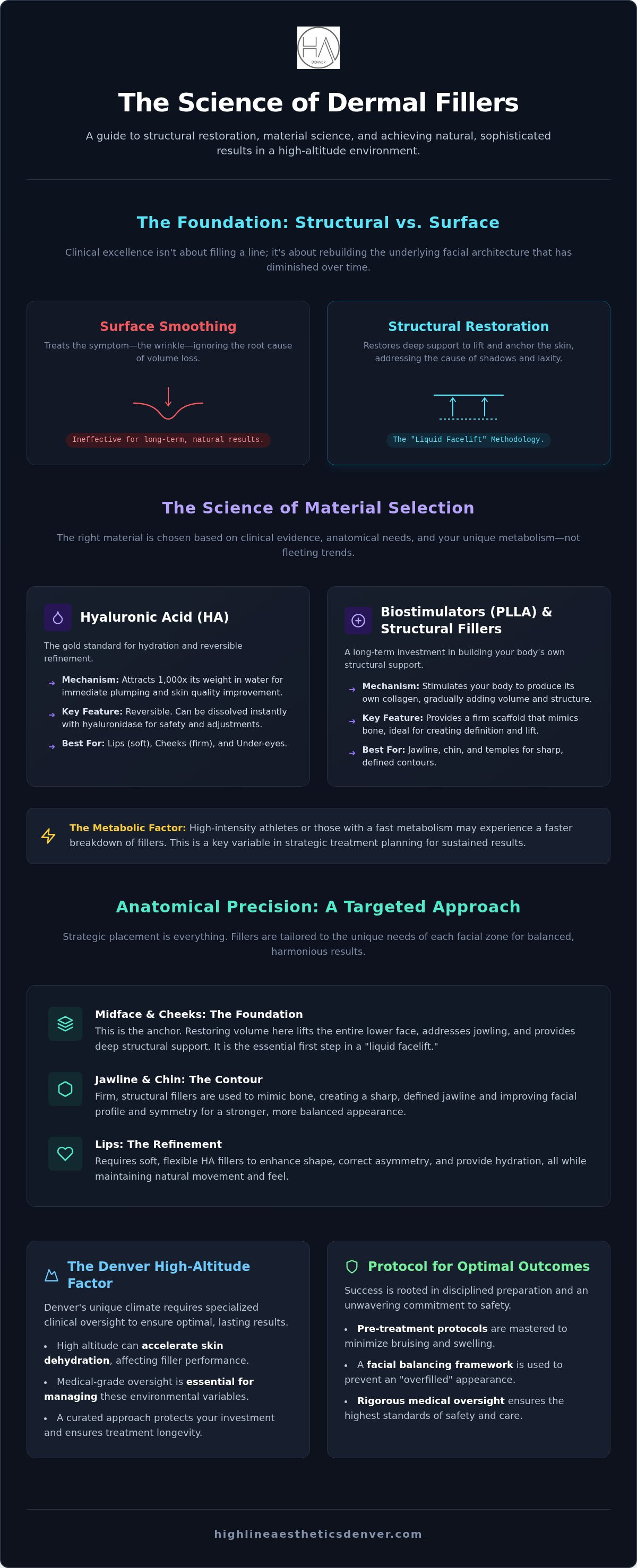
An Injectable filler is a biocompatible, gel-like substance placed strategically beneath the dermis to compensate for soft tissue deficits. While many view these treatments as simple "wrinkle erasers," clinical excellence requires a more disciplined perspective. We don't just fill lines. We restore the underlying architecture that has shifted or diminished over time. This approach, often termed a liquid facelift, prioritizes the restoration of a structural foundation over the superficial smoothing of a single fold.
The clinical difference between neuromodulators and injectable dermal fillers is fundamental. Neuromodulators target the musculature to temporarily suspend dynamic movement. In contrast, fillers address the physical loss of volume. As we age, the face undergoes bone resorption and fat pad migration. The cheekbones lose projection. The deep fat pads of the midface descend. If we only treat the resulting surface wrinkle, we ignore the root cause of the aesthetic decline. Our focus remains on the structural cause of the shadow, not just the shadow itself.
The Anatomy of Volume Loss
Structural integrity depends on deep-tissue support. When deep fat pads deplete, the overlying skin loses its anchor, leading to visible laxity and jowling. It's a logical progression. Bone and deep fat provide the scaffold. If that scaffold collapses, surface refinement is ineffective. We must address the volume loss in the deep compartments before attempting to refine the superficial layers. This sequence ensures a result that looks natural and balanced rather than over-inflated.
Fillers as a Non-Surgical Alternative
For many, injectable dermal fillers serve as a bridge that delays the necessity of invasive surgical procedures. We achieve significant refinement by restoring lost proportions without the extensive downtime associated with surgery. It's a process of deliberation and precision. Structural restoration is the primary goal of modern aesthetics, defined as the strategic placement of volume to rebuild the facial scaffold and harmonize anatomical proportions. By focusing on these deep foundations, we provide a sophisticated alternative to the traditional scalpel, allowing for a refreshed appearance through medical-grade precision.
The Science of Material Selection: Hyaluronic Acid, Biostimulators, and Metabolism
Material selection is a disciplined choice based on rheology and tissue integration. We don't choose products based on trends. We choose them based on clinical evidence. Your metabolic rate remains the most significant variable in treatment longevity. High-intensity athletes or individuals with elevated basal metabolic rates often experience faster enzymatic breakdown of FDA-approved dermal fillers. This is a physiological reality. It requires a strategic approach to dosing and product density. As a selective curator of these materials, Highline Aesthetics Denver accounts for these metabolic variables to ensure your investment delivers sustained results.
For areas requiring high structural resistance, such as the jawline or chin, Calcium Hydroxylapatite is the clinical standard. Its high G-prime rating provides the necessary lift to mimic bone structure. It doesn't just fill space. It provides a firm scaffold for new tissue growth. This material is particularly effective for patients seeking sharp, defined contours that won't soften or migrate over time. It is a precise tool for anatomical refinement.
Hyaluronic Acid: The Science of Hydration
Hyaluronic Acid (HA) is a naturally occurring polysaccharide. It possesses the unique ability to attract 1,000 times its weight in water. This creates an immediate plumping effect that improves skin quality from the inside out. The specific cross-linking technology used in the manufacturing process determines whether the filler is "hard" for cheek projection or "soft" for lip refinement. Most importantly, HA fillers are reversible. The enzyme hyaluronidase can dissolve the material instantly if a complication occurs or if the result requires adjustment. This safety feature makes HA the gold standard for many injectable dermal fillers.
Biostimulators: The Long-Term Investment
Poly-L-lactic acid (PLLA) functions differently than traditional fillers. It doesn't provide an immediate volume increase. Instead, it triggers a controlled, sub-clinical inflammatory response. This process stimulates the body's fibroblasts to produce new, native collagen. It's a "slow-burn" approach. Results emerge over several months as the body builds its own structural support. While HA provides an immediate "fill," biostimulators provide a structural "lift" that can last significantly longer. It is a long-term investment in the biological integrity of your skin, requiring patience and a commitment to the multi-session process.
Anatomical Precision: Tailoring Fillers for Lips, Midface, and Jawline
A disciplined aesthetic outcome relies on a Facial Balancing framework. We view the face as a cohesive anatomical unit rather than a collection of isolated parts. If we only address a single fold, we fail to achieve true harmony. Precision requires a global perspective. Injectable dermal fillers are tools for calibration. We use them to restore symmetry and refine proportions with a level of deliberation that respects your unique bone structure.
Midface restoration is the clinical priority for total facial rejuvenation. If the cheeks lose volume, the lower face inevitably descends. We treat the lateral cheek to act as a structural "hook," lifting the nasolabial folds and providing indirect support to the tear troughs. This avoids the "overfilled" look by addressing the root cause of the shadow. Similarly, lower face contouring focuses on the chin and jawline to create an assertive, balanced profile. A projected chin balances a prominent nose. A defined mandibular angle anchors the lower face. Every injection is a calculated step toward structural refinement.
Lip Refinement: Beyond Volume
Lip aesthetics require more than simple expansion. We focus on the vermillion border to restore lost definition and the philtrum columns to recreate youthful architecture. If we neglect the Cupid’s bow, the result looks artificial. We use ultra-fine injectable dermal fillers to address perioral lines without adding bulk. Maintaining dynamic movement is non-negotiable. Your lips must move naturally during speech and expression. We prioritize the preservation of function alongside the enhancement of form.
The Midface and Jawline: The Structural Pillars
The jawline and chin are the pillars of a refined lower face. We use high-density materials at the mandibular angle to create a sharp, "snatched" transition from the face to the neck. This provides the necessary tension to reduce the appearance of early jowling. Chin filler is equally critical for profile balancing. It provides the forward projection needed to harmonize the facial features. By strategically placing volume at these structural points, we rebuild the scaffold that time and gravity have diminished. This is clinical architecture in practice.
The Safety Protocol: Managing Risks and Optimizing Clinical Outcomes
High standards are the only standards. At Highline Aesthetics Denver, medical-director oversight is a non-negotiable component of every protocol involving injectable dermal fillers. Safety is not a marketing term; it is a clinical discipline. We operate with a "no-nonsense" philosophy that prioritizes the security of scientific validation over convenience. This rigorous approach ensures that every variable, from product selection to anatomical placement, is scrutinized for maximum efficacy and minimal risk. We are your partner in this process, and that partnership is built on the foundation of clinical safety.
Discipline begins before you enter the treatment room. We require patients to adhere to strict pre-treatment protocols, such as avoiding blood-thinning medications and specific supplements for at least one week prior to injection. If you minimize systemic thinning, then you significantly reduce the risk of post-procedural bruising and swelling. Intra-treatment precision is equally critical. We frequently utilize micro-cannulas rather than traditional needles. These blunt-tipped instruments navigate the sub-dermal layers with less trauma. This choice drastically lowers the probability of accidental vascular entry and improves the overall recovery experience.
Post-treatment vigilance is the final pillar of our safety framework. While localized swelling is a standard physiological response, we educate every client on the specific markers of vascular compromise. If you experience skin blanching, mottled discoloration, or pain that feels disproportionate to the procedure, immediate clinical intervention is required. We don't leave these outcomes to chance. Our team is trained to recognize and manage complications with speed and technical expertise.
The Clinical Injection Process
A sterile field is the baseline for any medical-grade aesthetic procedure. We maintain a high-grade clinical environment to prevent infection and ensure tissue integrity. Pain management is integrated into the process through the use of lidocaine-infused products and high-potency topical numbing agents. We advocate for a gradual, multi-session approach. This method allows the tissue to integrate the material naturally, preventing the "overfilled" look that occurs when too much volume is introduced in a single sitting. Precision takes time.
Recovery and Longevity Maintenance
The first 72 hours are the most critical for stabilization. You should expect mild inflammation as the body responds to the structural refinement. During this window, you must avoid strenuous exercise, excessive heat, and any invasive dental work. These activities increase blood flow or introduce bacteria, both of which can compromise the final result. Scheduled follow-up assessments are essential to evaluate tissue integration and determine if minor refinements are necessary to achieve the desired outcome. To begin your structured journey toward refined results, schedule a clinical consultation at our Denver boutique.
The Highline Philosophy: Selective Curation for Denver’s High-Altitude Environment
Clinical excellence is not a universal standard; it is a local one. In Denver, our environmental variables demand a more sophisticated approach to injectable dermal fillers. We operate as a Selective Curator. This means we reject fleeting trends in favor of materials that have undergone rigorous scientific scrutiny. Every product in our clinic is vetted for its rheological properties and tissue integration. Our commitment to evidence-backed results ensures that every choice is deliberate. We don't follow fashion. We follow data. This disciplined methodology is the only way to achieve structural refinement that stands the test of time.
Boutique Care in the Golden Triangle
High-volume, "cookie-cutter" medical spas prioritize turnover. We prioritize refinement. Our boutique clinic in the Golden Triangle offers a private, disciplined environment for personalized aesthetic planning. This is where science meets strategy. Our "Relentless Expert" persona is not just a brand identity; it is a safety protocol. By focusing on a limited number of clients, we ensure that every structural refinement is executed with unwavering attention to detail. We move away from generic templates. Instead, we build a customized roadmap for your anatomical restoration. We invite you to begin a structured process where your long-term success is the only metric of our performance.
High-Altitude Skin Science
Denver’s arid, high-altitude climate presents unique challenges for Hyaluronic Acid (HA) performance. Since HA molecules are hydrophilic, they require adequate systemic and topical hydration to maintain their volumizing effects. If the environment is too dry, then filler longevity and the quality of the "plumping" effect may be compromised. We understand this physiological reality. It is why our approach to injectable dermal fillers includes a focus on the total skin environment. We don't just inject a gel; we manage a biological outcome.
Optimal results require a multi-dimensional strategy. We often recommend combining fillers with wellness therapies, such as IV hydration, to optimize the body's internal environment. If your system is hydrated, then your HA fillers will perform with greater efficacy. Topical hydration and medical-grade skincare are also essential components of our post-treatment care. They support the dermal scaffold from the outside in, ensuring your results remain resilient against the harsh Colorado elements. This results-oriented journey moves from the initial consultation through to the final structural refinement. Nothing is left to chance. Schedule your clinical consultation at Highline Aesthetics Denver to begin your personalized aesthetic journey today.
Structural Refinement: Your Path to Disciplined Aesthetics
Achieving sophisticated results requires moving beyond the superficial. Structural refinement is a process of deliberation. It demands a deep understanding of how injectable dermal fillers interact with your unique anatomy and the specific environmental stressors of the high-altitude climate. We've analyzed the science of material selection and the necessity of rigorous safety protocols. These are the non-negotiable foundations of excellence. At Highline Aesthetics, we don't settle for "good enough" or follow industry trends without validation. Our boutique clinic operates with strict Medical Director oversight for every treatment to ensure patient safety and technical precision.
Located in Denver's prestigious Golden Triangle, we prioritize clinical rigor and data-backed results over the typical wellness experience. If you're ready to partner with a team that values substance and evidence, then the next step is a structured clinical assessment. We'll evaluate your anatomical needs and develop a precise roadmap for your restoration. Book a Science-Backed Consultation at our Golden Triangle Clinic to begin your journey toward expert-led refinement. We're committed to your long-term success through scientific validation.
Frequently Asked Questions
What is the primary difference between dermal fillers and Botox?
Dermal fillers and neuromodulators target different aging mechanisms. Fillers address static volume loss by physically lifting the tissue scaffold and restoring lost structure. Botox targets dynamic wrinkles by temporarily suspending muscle movement. If you have deep folds at rest, fillers are the solution. If you have lines that appear only with expression, neuromodulators are appropriate. A disciplined approach often combines both for total facial balancing.
How long do injectable dermal fillers typically last in the face?
Longevity depends on product density and your individual metabolism. Hyaluronic acid injectable dermal fillers typically last between 6 and 18 months. Biostimulatory materials like PLLA can provide structural support for up to two years. High-intensity activity or elevated metabolic rates will cause the material to break down faster. We monitor these variables to determine your optimal maintenance schedule and ensure sustained refinement.
Is the dermal filler injection process painful?
Discomfort is minimal due to integrated pain management protocols. Most modern fillers contain lidocaine, which numbs the tissue as the material is placed. We also use high-potency topical numbing agents and blunt-tipped cannulas to reduce trauma. If you're sensitive, we take additional steps to ensure the experience is tolerable. Precision doesn't require unnecessary pain. We prioritize a comfortable, clinical environment for every structural procedure.
Can dermal fillers be reversed if I am unhappy with the results?
Hyaluronic acid fillers are fully reversible using the enzyme hyaluronidase. This allows us to dissolve the material instantly if an adjustment is needed or a complication occurs. However, non-HA biostimulators like PLLA or Calcium Hydroxylapatite aren't reversible. We prioritize HA for first-time treatments because it offers a higher safety profile. This safety feature is a critical component of our medical-grade standard for all patients.
What is 'facial balancing' and how many syringes of filler will I need?
Facial balancing is a global assessment that harmonizes the chin, cheeks, and lips as one unit. The number of syringes required varies based on your existing anatomical deficits. A typical full-face restoration often requires between two and six syringes. We don't use a "cookie-cutter" approach. We determine the exact volume needed to rebuild your structural foundation without creating an overfilled or unnatural appearance.
Are there specific risks associated with fillers in high-altitude climates like Denver?
Denver's dry climate impacts the hydration of injectable dermal fillers. Since HA molecules attract water, extreme dehydration can cause the filler to appear less effective or break down prematurely. We address this by integrating systemic hydration strategies like IV Wellness Therapy into your plan. If you maintain high hydration levels, then your fillers will perform with greater longevity and much better aesthetic refinement.
How soon will I see the final results after my filler treatment?
You'll see an immediate change in volume, but final results require two weeks to settle. Initial swelling and tissue integration take time to stabilize. If you're using biostimulators, the collagen-building process takes several months to reach full efficacy. We schedule follow-up assessments at the two-week mark to evaluate the final settling of the material. Patience is a requirement for high-end, sophisticated refinement.
Can I combine dermal fillers with other treatments like microneedling or lasers?
Combining fillers with energy-based treatments is a standard protocol for comprehensive rejuvenation. We often pair fillers with microneedling or RF skin tightening to address both volume and surface texture. However, the timing is critical. We typically wait two weeks after filler placement before performing heat-based laser treatments to ensure the material has stabilized. This sequenced approach yields the most disciplined and effective results.


Comments